Bird-watching at Doi Inthanon National Park can be a fun and an interesting way to discover nature at a leisurely pace. As you read this article you will learn more about Doi Inthanon than just birds but also about the environment in which they live.
Click on the Birds underlined in blue to see the photos we took while on tour with All Thailand Experiences birding tour.

Of the total of 382 species of birds and 1600 species and subspecies of Butterflies are so far known from Doi Inthanon, at least 266 bird species are resident or were formerly resident on the mountain. The status of a further 12 bird species is unclear, but breeding is suspected in many of these. The remainder (104 species) are non-breeding winter bird visitors or passage migrants.
If the known distribution of species is examined in relation to ecological zone, it can be seen that by far the highest species total has been recorded in the moist, tall hill evergreen forest lying between 1500 and 2000 meters (Zone 2). While this may be partly due to coverage (some other vegetation types, for example, pine forest, are less frequently visited by birdwatchers and certainly support a few more species than recorded here) this nevertheless does appear to accurately reflect the real differences in bird species diversity among these various zones. The small area of hill evergreen forest above 2000 meters (Zone 1), has probably been covered even more intensively than Zone 2 and although it supports a number of rare and local high elevation species which are not found elsewhere, it yet supports fewer species overall than does Zone 2.
A surprisingly large total (139 species) has been recorded from deforested areas and cultivation above 1000 m (Zone 4). However, only 59% of the species in this zone are resident, compared with 78% in Zone 2. Fewer species still have been recorded from the deciduous habitats (Zones 6 and 7).
Doi Inthanon is of particular conservation importance for those species which inhabit the moist hill evergreen forests of the upper slopes. Some, such as the Chestnut-tailed Minla and White-browed Shortwing, which are abundant around the summit of Doi Inthanon, occur in Thailand only on those few higher mountain summits which have considerable areas of hill evergreen forest above 1800 m. Doi Inthanon contains the only significant protected populations of such species in Thailand. The Ashy-throated Leaf-Warbler is found nowhere else in Thailand while an endemic race of the Green-tailed Sunbird (Aethopyga nipa/ensis angkanensis) is also completely confined to the summit of Doi Inthanon. Both species are among the more abundant birds found around the summit of the mountain.

Doi Inthanon comprises some of the tallest and best preserved montane forest found anywhere in the entire country. The predominance of massive, huge-boled trees may be of particular significance for trunk-foraging species such as the Brown-throated Treecreeper. The profusion of epiphytes and the lush, moist understorey also contribute to the great variety of foraging niches for small, insectivorous birds.
Many larger birds, such as the white-winged wood duck and most hornbills, have probably been extirpated due to hunting pressure. Great hornbills were last reported by Dickinson ( 1964) and although a single rufous-necked hornbill (a species which is threatened throughout its world range from the Himalayas across to Northern Indochina) was reliably seen as recently as 1986, it is however, appear to have fared better: black eagle, rufous-bellied eagle, and mountain hawk-eagle are all frequently seen. Although both galliformes and pigeons have also suffered adversely from illegal hunting, some species are still fairly common.
Although this article will help you understand where the birds reside spotting them can be difficult. This is where a local guide who lives in the park is very valuable. They are out everyday sighting birds and will help you save time and money looking for them. Check here for information on local guides, transportation and accommodations at Doi Inthanon National Park.
WHEN TO WATCH BIRDS ON DOI INTHANON
Doi Inthanon is good for birdwatching throughout the year though perhaps the best time is from February through to April when most resident species are breeding and, in addition, a full complement of winter visitors is usually present. Also, during the early part of the breeding season many of the resident species are more inclined to be singing or calling and are therefore more easily located.
The early wet season, during May to July, is also a very interesting time for the birdwatcher, especially since many species are still feeding fledged young. In addition, some ground feeding species such as pittas and thrushes, which favor wetter conditions, now start to breed. Though showers are fairly frequent at this time, the weather is seldom bad enough to interfere too much with birdwatching, unless you are unlucky enough to time your arrival on the mountain with the passage of a deep monsoon trough. Later in the wet season, however, rain is more of a problem, particularly around the summit, which can be blanketed in mist and rain for days on end. This period, from July onwards to October, is usually the quietest period for birds, though even then, many interesting observations can be made. It is a particularly good time to look out for passage migrants and for the return of the first winter visitors.
INTRODUCTION
Birdwatching at Doi Inthanon National Park can be a fun and an interesting way to discover nature at a leisurely pace. You can easily cover many kilometers in a day without getting tired because you spend more time looking then walking. You pay more attention to the sounds and beauty of the forest so you discover many wonderful things you would normally miss if just hiking.
As you read this article you will learn more about Doi Inthanon than just birds but also about the environment in which they live.
A bird checklist is provided for our clients who bird with us at All Thailand Experiences.
This article has the following chapters:
BIRDS OF DOI INTHANON LOCATION
Park Gate to Kilometer 14 (altitude 300 to 500 meters: – Zones 7 to 10).
Kilometer 14 to 23 ( altitude 500 to 800 meters : Zones 6 to 8).
Kilometer 23 to 29 ( altitude 900 to 1200 meters : Zones 3 to 6).
Kilometer 30 to 34 ( altitude . 1200 to 1500 meters : Zone 4).
Kilometer 34 to 40 ( altitude 1500 to 1900 meters : Zone 2).
Kilometer 40 to 46 ( altitude 2000 to 2565 meters : Zone 1).
BIRDWATCHING ON DOI INTHANON
Since most visitors will approach Doi Inthanon along the road from Chom Thong, we describe the route as it ascends the mountain, point out those habitat features of particular interest and suggest which bird species to look out for.
Park Gate to Kilometer 14 (altitude 300 to 500 meters: – Zones 7 to 10) .
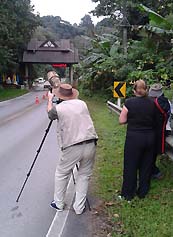
Soon after entering the park gate, the road climbs steeply through a cutting before leveling out, passing the Doi Inthanon National Park Information Center, overlooking the Mae Klang river on the left. The road passes through open dry dipterocarp forest and after crossing over to the left bank, follows the course of the river, overlooking it. This forest type is of rather low stature trees, chiefly Shorea siamensis and S. obtusa, with Dipterocarpus tuberculatus and D. obtusifolius being codominant in some places. In the dry season, the leaves of the trees become yellow and red, before being shed. There is usually a fresh flush of green foliage in April, however, when the first showers announce the impending wet season. The understorey is open and grassy. Fires, deliberately set by local people, sweep through the ground story in the dry season, from February onwards. In the heat of the day, this forest type may seem to be almost devoid of birds, but in fact, it is quite rich, especially in medium to large-sized species. Early morning is the best time to birdwatch here. Look out for Collared Falconets and Lineated Barbets perched high up in dead snags. The Indian Roller is also common. Many species of woodpeckers occur, including the scarce Black-headed and White-bellied Woodpeckers, while Eurasian Jay is fairly common. The beautiful Blue Magpie and strikingly marked Rufous Treepie are less easy to see. The magpies are highly social and usually found in small flocks, especially in the early morning, when they often descend to the river to drink. The Chinese Francolin haunts the grassy understorey while, if you scan the skyline, you may pick up a soaring bird of prey. The Shikra is common, but Black Baza, Crested Serpent Eagle and Rufous-winged Buzzard are often seen.
Smaller birds appear scarce and are apt to be concentrated in small feeding flocks, especially in bamboo brakes and denser foliage in steep gullies and along small permanent streams. Look out for Common Wood-Shrike, Small Minivet, Chestnut-bellied Nuthatch, White-crested and Greater Necklaced Laughingthrushes, Blue-throated and Tickell’s Blue Flycatchers. A number of migrant species, including both Yellow-streaked and Radde’s Warblers, may be found.
It is worth carefully searching along the edges of the river for riparian species. The rather scarce Black-backed Forktail is a typical inhabitant of streams of the foothills and wintering Little Herons, White Wagtails and Grey Wagtails may also be seen.
Kilometer 14 to 23 ( altitude 500 to 800 meters : Zones 6 to 8).

As the road climbs gradually, an evergreen gallery forest begins develop along the banks of the river, supporting many tall and stately dipterocarp trees. Away from the river, however, the forest type is still predominantly dry dipterocarp. In addition to the bird species found in the preceding area, Large Wood-Shrike and Black-hooded Oriole should be looked for. Soaring birds of prey can sometimes be seen over the steep ridge on the north side of the road, on the opposite bank of the Nam Mae Klang. The more level areas in the vicinity of the river are now cultivated and support small areas of orchard or vegetable gardens. The exposed rocks of road cuttings sometimes support the Blue Rock Thrush, a winter visitor. The impressive Vachiratharn waterfall is situated towards the upper end of this section and has a vertical drop of roughly 50 meters This is one of the best sites on the mountain for observing birds of fast-flowing streams. Walk down the steps leading to the main fall, looking out for the Plumbeous Redstart and the River Chat (White-capped Water Redstart), which often perch on boulders in midstream, fly catching to take insects from the air or from the water’s edge. The large and more robust Blue Whistling Thrush often wades into the stream to pluck out food items, or sits unobtrusively under rock overhangs. The Brown Dipper, recorded here in the past, has not been seen for many years. Where the current is weaker, well upstream of the main fall, the Slaty-backed Forktail and White-Crowned Forktail can sometimes be seen. This illustrates well the altitudinal segregation between this species, which is more a bird of the mountains, and Black-backed Forktail, which is strictly a bird of the foothills, well downstream of the waterfall.
The constant fine spray from the fall appears to allow more evergreen trees to grow here and a few birds characteristic of higher elevations, such as the White-headed Bulbul, begin to appear.
Kilometer 23 to 29 ( altitude 900 to 1200 meters : Zones 3 to 6).
Above the waterfall, the road once again crosses over the Mae Klang river and continues to ascend the mountain, following the north bank. The surroundings change very abruptly in character, and pines predominate in many areas. The pine forest appears to support a lower diversity of birds than other forest types. A few species, such as the Great Tit, are more or less confined to pine forests in northern Thailand but most other species which occur here, such as Large Hawk-Cuckoo, Grey-headed Woodpecker, Eurasian Jay and Velvet-fronted Nuthatch are ecologically tolerant species which also occur in a variety of other woodland types. The Inornate Warbler, Red-throated Flycatcher and Olive Tree-Pipit are among the commonest wintering species found. Such broadleaved woodlands as remain are mostly low-stature , secondary regrowth but support a number of smaller resident species, including Buff-breasted Babbler and Brown-cheeked Fulvetta. The rare , Giant Nuthatch which is one of the few species which is positively associated with pines, has not been seen on Doi Inthanon for many years but should be looked for in this zone, particularly towards its upper altitudinal limits where the pines begin to intergrade with broadleaved evergreen trees such as oaks .
Along the course of the Mae Klang are many Karen rice terraces. Dry stubble occasionally supports White-rumped Munias and the occasional wintering Chestnut Bunting or even Chestnut-eared Bunting. In recent years, however, many more cabbages and other vegetable crops are being grown on these terraces and they generally support fewer birds.
Look out for birds of prey, such as Crested Honey-Buzzard, or the wintering Common Buzzard or Grey-faced Buzzard. Towards the end of this section, a rocky crag overlooks the road and may provide nesting habitat for species such as House Swift Apus affinis and Red-rumped Swallow Hirundo daurica.
Kilometer 30 to 34 altitude . 1200 to 1500 meters : Zone 4).
This area has borne the brunt of deforestation due to upland shifting cultivation and virtually all native forest has been cleared. Little more than 4 decades ago, the area was dominated by scrub and grassland, among which were scattered a few opium poppy fields. During the past 3 decades, however, there has been a great increase in horticultural activity under the auspices of the Highland Agricultural Project and a great variety of fruits and vegetables are now grown. In addition, many areas have been replanted with Pinus kesiya, so that dense stands of conifers are now covering the formerly denuded hills. This area also supports a large human population. In addition to nearby Hmong and Karen villages, there are many government offices and residential buildings. including the headquarters of the National Park and various highway and construction works. In spite of such a high level of human activity, the scrublands and cultivated areas continue to support a great variety of birds. Lowland species such as Red-whiskered and Sooty-headed Bulbuls, White-browed Scimitar-Babbler, Pied Bushchat and Long-tailed Shrike occur alongside such mountain birds as Flavescent Bulbul, Rusty-cheeked Scimitar-Babbler, Hill Prinia and Pale-footed Bush-Warbler. In such moist secondary growth as remains, particularly along watercourses, a number of the more tolerant forest birds, including Orange-bellied Leafbird, Blue Wing Leafbird, Blue throated Barbet, Verditer Flycatcher and Slaty-blue Flycatcher are found. During the late dry season, from January onwards, a number of red-flowed Erythrina trees are in blossom. These produce copious nectar which attracts a great many birds. Look out for the rather scarce White-headed Bulbul among the commoner species such as Red-whiskered Bulbul Occasional flocks of Long-tailed Minivets may also be seen during the winter months.

This area supports a great number of winter visitors, including Siberian Rubythroat, and Buff-throated, Yellow-streaked and Radde’s Warblers, all of which inhabit dense banks of scrub and herbage, while Stonechats, Olive Backed Pipits, White Wagtails and Little Buntings occur in the more open areas. The Grey Bushchat may be seen here commonly during the winter months as a breeding bird, however, it is usually restricted to the higher elevations .
The national park headquarters is situated at Km 30, beyond the Hmong village of Ban Khun Klang.
Kilometer 34 to 40 ( altitude 1500 to 1900 meters : Zone 2).

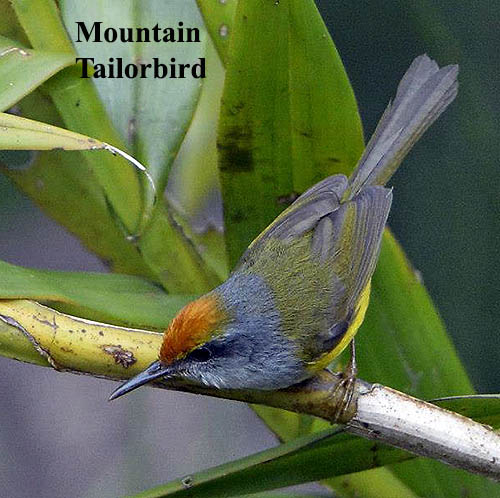
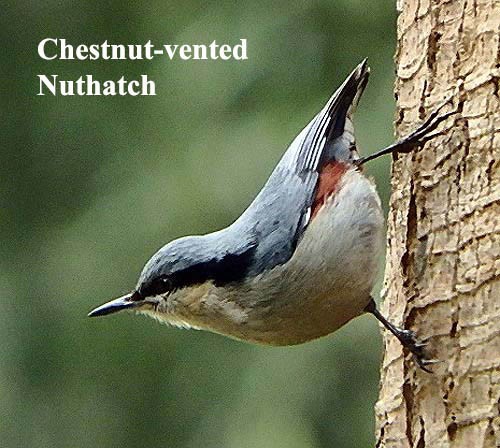
This section supports some of the best broadleaved hill-evergreen forest on the mountain. Although the action of fire, sweeping into the margins of this zone from the cultivated areas below, combined with road construction activities, has “thinned” the forest edge in places, large expanses of dense forest supporting many tall, large-boled trees remain and there is a good deal of lush, moist ground storey vegetation, particularly along small forest brooks. The vegetation along the road is much disturbed with many secondary and pioneer fruit-bearing shrubs. As already mentioned, this zone has a higher bird species diversity than any other: among its characteristic reside species are the Mountain Imperial Pigeon, Great Barbet, Golden-throated Barbet, Stripe-breasted Woodpecker, Bay Woodpecker, Maroon Oriole, Yellow-cheeked Tit, Golden Babbler, White-necked Laughingthrush, Blue-winged Minla, Grey-cheeked Fulvetta, Rufous-backed Sibia and Large Niltava among many more. In the more disturbed edges may be found the Silver-eared Mesia, Spectacled Barwing and Mountain Tailorbird. Tall dead trees are a favoured haunt of the Chestnut-vented Nuthatch. Birdwatching along the road can be quite productive, particularly in the vicinity of the checkpoint at Km 37.5, where a road forks off towards the village of Mae Chaem, or at Km 3 where a dirt road forks off towards the south. There are very few trails, which makes access into the areas of moist forest understorey difficult. By the check-point at Km 37.5 a dirt track leads off to the north and provides access into the forest interior. Otherwise, the more adventurous observer must find his own way, usually by following ridge tops or seeking out small streams and following them.
Among the many scarce arboreal birds to look out for are Red-headed Trogon, Long-tailed Broadbill, Brown-throated Treecreeper, Asian Emerald Cuckoo and Green Cochoa. The many secretive ground-living and understorey birds include Rufous-throated Partridge, Silver Pheasant, Rusty napped Pitta, Pygmy Wren-Babbler, Lesser Shortwing, White-tailed Robin, Slaty-bellied and Chestnut headed Tesias, White-gorgetted Flycatcher and Small Niltava. No birdwatcher ever manages to see all of these species on a single visit, and indeed the impossibility of predicting which of these or any other species one will encounter is something which merely adds to one’s excitement and constant sense of anticipation. The resident White-tailed Leaf Warbler is one of the commonest birds in the forest, though a number of wintering leaf-warblers are also found here. Another winter visitor, the Eye-browed Thrush, is often seen in small flocks feeding either on the forest floor or in the treetops.
Kilometer 40 to 46 ( altitude 2000 to 2565 meters : Zone 1).
The road continues through this section to the summit. It initially traverses an exposed, windswept grassy ridge, before once more entering the forest. Here, where rocky road cuttings are found adjacent to forest trees, one should look out for the Dusky Crag Martin and for the Chestnut-bellied Rock Thrush which has been recorded throughout the year and is believed to breed here. The forest in this zone is Characterized by an abundance of Rhododendron and other species of the families Ericaceae, Theaceae and Magnoliaceae. The trees are of lower stature than in the preceding zone and are frequently swathed in epiphytes.

Many of the bird species in this zone are shared with the preceding zone but some, such as the Chestnut-crowned (silver eared) Laughingthrush and Rufous-winged Fulvetta, are much more abundant here. The Chestnut-tailed Minla and Dark-backed Sibia are among the commonest babblers. The Mountain Imperial Pigeon is still the commonest pigeon species, though both the scarce resident Ashy Wood-Pigeon and the wintering Speckled Wood-Pigeon should be looked out for. Thailand’s second resident species of leaf-warbler, Ashy-throated Leaf-Warbler, is extremely common, occurring alongside the White-tailed Leaf-Warbler. The migrant Orange-barred Leaf-Warbler is also abundant during the winter months. Another winter visitor, the Common Rosefinch, may sometimes be seen in large numbers This species often frequents the dense banks of brambles (Rubus sp.) along the roadside margins. Both the Common Tailorbird and the Hill Prinia are also common here.
Across the road from the highest point of the mountain, a narrow footpath leads down into a small sphagnum moss bog. This is one of the best spots on the entire mountain for birdwatching. Many of the birds are extremely confiding and will approach quite close to a quiet and patient observer. The brightly-colored and endemic form of Green-tailed Sunbird, which is resident on the mountain, is extremely common. During the winter months, it may be seen alongside the somewhat similarly-marked Gould’s Sunbird, which is a migrant visitor. One of the greatest treats in store for the observer in February or March is to watch both these “living jewels” feeding on the nectar of the beautiful blood-red flowers of Rhododendron delavayi, one of the many species of flowering plants for which Doi Inthanon is the only station in Thailand.
In addition to the great variety of arboreal birds, the watcher should look out for the many shy or scarce ground-feeding species which frequent moist, leaf-strewn muddy patches around the margins of the bog. The White-browed Shortwing is quite common; normally rather shy and somewhat difficult to see, it becomes very bold and confiding during the breeding season, from February through to May. The resident Dark-sided Thrush can sometimes be seen digging craters in the soft mud with its heavy, curved bill while one or two pairs of Snowy-browed Flycatchers haunt the ground storey vegetation.
The Eurasian Woodcock is an annual winter visitor, as is the Orange-flanked Bush-Robin. Wintering thrushes can be abundant here; in most years, one or two scarce Grey-sided Thrushes can be seen feeding unobtrusively on the forest floor or sitting in the treetops with the much commoner, but similarly marked, Eye-browed Thrush. In some years, irruptions of other thrush species occur, perhaps with the onset of unusually cool weather in south-west China. Long-tailed Thrush, Chestnut Thrush, Red-throated Thrush and Dusky Thrush have all been seen on the summit of Doi Inthanon.
A national park substation and toilet facilities are provided at the mountain summit.NOTICE: If you plan to bird watch at Doi Inthanon during the months of October throough March and need accommodation is the park you will need to make reservations at least 3 months in advance, you can do so here.
WHEN TO WATCH BIRDS ON DOI INTHANONDoi Inthanon is good for birdwatching throughout the year though perhaps the best time is from February through to April when most resident species are breeding and, in addition, a full complement of winter visitors is usually present. Also, during the early part of the breeding season many of the resident species are more inclined to be singing or calling and are therefore more easily located. The early wet season, during May to July, is also a very interesting time for the birdwatcher, especially since many species are still feeding fledged young. In addition, some ground feeding species such as pittas and thrushes, which favor wetter conditions, now start to breed. Though showers are fairly frequent at this time, the weather is seldom bad enough to interfere too much with birdwatching, unless you are unlucky enough to time your arrival on the mountain with the passage of a deep monsoon trough. Later in the wet season, however, rain is more of a problem, particularly around the summit, which can be blanketed in mist and rain for days on end. This period, from July onwards to October, is usually the quietist period for birds, though even then, many interesting observations can be made. It is a particularly good time to look out for passage migrants and for the return of the first winter visitors.
Have questions about Thailand and our tours and soft adventures? We will be happy to answer them for you.
Doi Inthanon National Park Bird Watching
Share this:


 All Thailand Experiences