Chiang Mai Thailand Accommodations, Food, Night Life, Travel and Tour Advice.
About the Author: Mr. Randy Gaudet, founder and director of All Thailand Experiences has been living in Chiang Mai and north Thailand since 1989. Randy has written many informative blogs, articles and stories about his experiences in north Thailand.
Many guide books on Thailand only partially cover the real life experiences in Chiang Mai, I have been living here since 1989 so I would like to give you some advice about protocol, travel and accommodations in and around the city of Chiang Mai Thailand. Hopefully it will help you to enjoy your travels in Northern Thailand.
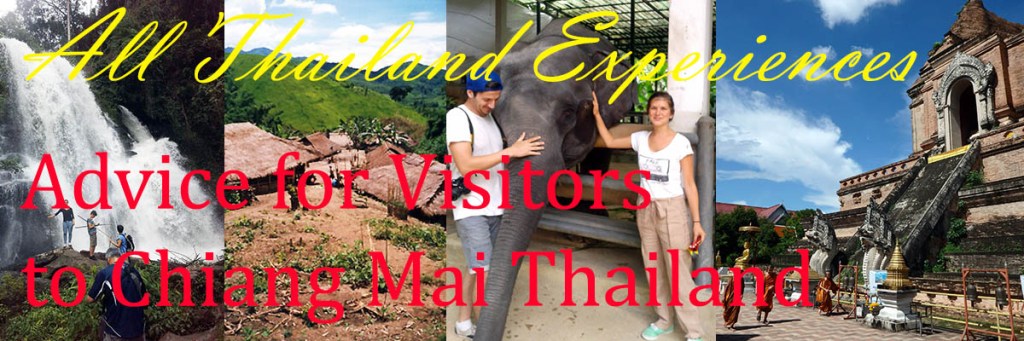
In the foot hills of the Himalayan Mountains 800 kilometers north of Bangkok is the culturally rich city of Chiang Mai.
Chiang Mai is the longest continuously lived in settlement from the ancient days of Siam.
Chiang Mai could only be reached by an arduous river journey or an elephant back trip until the nineteen twenties. Chiang Mai’s distinctive charm is still intact up to the present day.
Transportation:
When you arrive in Chiang Mai Thailand, it helps to know a bit about transportation within the city. At the airport, train station, or bus station, you will probably be met by the representatives of various guesthouses and hotels and tour operators. If you have a specific place in mind and you don’t see the specific signboard, you can always call the place to have someone pick you up from the train station, airport, or bus arcade depot. Taxis are available at the airport, with a price of 150 baht to most destinations.
The common vehicles of public transportation are more varied than public buses. The terms ‘tuk tuk’ and ‘samlaw’ are open-air, three-wheel vehicles, and ‘zeelor’ and ‘songthaow’ describe vehicles with four wheels. Whenever you get in a ‘tuk tuk’, ‘zeelaw’, or ‘samlaw’, you should make sure that they take you where you want to go. Often the drivers work on commission and may tell you that the place you want to go is dirty, closed, or full if they don’t have a previous agreement with the place you have in mind. Always negotiate the price before you get in a tuk tuk or samlaw. A zeelaw ride should cost 15 Baht on a regular route, more if you hire it out to go somewhere out of the way.

The best way to get around Chiangmai is by ‘songtaow’. These are covered pick-up trucks with two benches in the back. “Songtaow” means “two benches” in Thai. You will see them everywhere, and it’s easy to get them to pick you up. All you need to do is to put your arm out and look at the driver, and they will stop. Then tell the driver which street you want to go to, and if he is going that way, he will shake his head “yes”; if not, he will say “no” and go on. Don’t worry—there will be another one right behind him. When the driver turns down the street you want, start looking for where you want to get off and press the switch located on the roof of the cab. The driver will pull over, let you out, and then you pay him.
The fare should be 20 Thai baht or less (around 50 cents). If you tell the driver a hotel or establishment, he will think you want to hire him for a private trip, and the price will be much more. Negotiate any price beforehand if you want to go to an establishment.
Renting a motorbike or scooter:
There is a wide variety of two wheeled transportation available in Chiang Mai from loads of rental agencies. Price start from just a few dollars a day for a 100CC automatic scooter to large harley Davidson cycles, off road dirt motorbikes and every thing in between. It is important to know which type of motor bike works best for where you plan to ride.
IMPORTANT: Most people rent the automatic small scooters however this is very dangerous if you plan to travel into the mountain countryside or to Doi Suthep Temple on the mountain above the city. This is because when going downhill the scooter goes into neutral so you are free-wheeling and must use only your brakes to slow you down. If there are 2 of you on the scooter going downhill you could have a brake failure and find yourself in big trouble. The automatic scooters are made for riding in the city only not in the mountains.
If you are going to go into the mountains rent an automatic clutch motorbike or better so you can downshift when going downhill so the engine can help you slow down. A Honda Dream or Honda Wave is great for beginner riders and has an automatic clutch and a 4 speed transmission so you can downshift to help slow you down and also has a better power range when going uphill.
When you rent any form of transportation take photos from every angle of the vehicle to show the condition of the vehicle before you rent it. This will protect you from any rental agency trying to get you pay for damage that was there before you rented the vehicle.
Accommodations:
Booking accommodations might be the biggest decision you will make while visiting Chiang Mai. I hear many visitors saying “Chiang Mai has no real culture as there are too many tourists”. If you stay in the city center inside the moat and city walls, tourists is all you will see. The Chiang Mai locals call this area “Tourist Town”
Since 2010 over 100 new guest houses, small boutique hotels, restaurants, tourist souvenir shops and pubs have been built within or near the moat and old city walls. The establishments have now claimed this area as “The Old City” which is far from the truth. The real “Old City” is the area of “Gatluang” near Wararot Market located along the Ping River where all the commerce, traders and craft persons worked and lived. Inside the city walls is where the Royal Family, temple monks, Royal staff and elite military resided. The citizens of Chiang Mai were only allowed inside the old city walls during festivals, Buddhist holidays and with Royal events.
Today most of the business and residents inside the old city walls and moat are owned and operated by people from Bangkok and expats. This area now is more like the heavy touristy Kaosan Road in Bangkok than the culturaly rich Chiang Mai.
Another popular place is Nimmanhemin road in The “Huay Khao” area. This part of the city is where most of the expats live with condos, coffee shops and shopping malls catering to the western lifestyle. Again most shops owned and operated by those from Bangkok or expats, not much Thai culture here and prices are rather high so Thai people cannot afford to go there.
You can avoid the large number of tourists and experience the real charm of Chiang Mai by staying only 2 or 3 kilometers from the city walls and moat, not only that but at a lower price. There are wonderful communities where you can visit local markets, temples and talk with locals in their shops and restaurants. Experience real Thai food and daily life of local communities. The guest houses and small boutique hotels are far apart and you can get a ride by “Songtaow” into the city center within minutes.
Some of these areas are “Sanpakhoi” just across the Ping River on the Narawat Birdge. This is the home of the first Christian church in Chiang Mai, the lively Sanpakhoi market and Kawila Boxing Stadium. “Waulai” Area is across the street and moat from Chiang Mai gate and home of several small silversmiths, The silver temple at Wat Si Suphan and the Saturday night walking market.
Try booking your guest house or small hotel east of the Ping River or the old silver making area north of town near Wualai road. Waulai road has the Saturday night Walking Night Bazaar and home of the beautiful Silver Temple “Wat Siri Suphan”.
Culture:
The Thai people have several customs that are important to remember to avoid causing offense. Never touch the head, because it is the most sacred part of the body. The feet are the lowliest part, so don’t point them at others or rest them above ground level. Never stop a rolling Thai Baht coin or any type of Thai currency with your foot, as the money here has a picture of the king on it.
Respect for the king and religious customs is another important part of Thai protocol. They have great respect for the royal family, the flag, and anything with an image of the king, including the money. When you visit a Buddhist temple, you should always remove your shoes before entering any buildings. Men should wear long pants, and women should wear knee-length or longer skirts. Women are not allowed to touch monks or make prolonged eye contact with them. Do not sit on the walls surrounding the jedee, which contains the temple’s sacred relics of the Buddha.
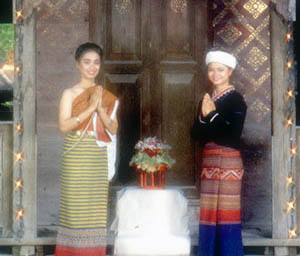
Meeting and making friends with different people is an exciting part of travel anywhere. In Northern Thailand, it helps to know a bit of the language and something about the protocol. To say “hello”, say “Sawatdee Krup” for men and “Sawatdee Kha” for women. To learn more Thai before you come, an excellent free teaching website can be found at http://www.learningthai.com/. You will gain loads of respect from the Thai people if you learn just the basics.The Thais put a lot of emphasis on manners, so it’s a good idea to learn to say “Thank you”. In Thai, it’s “Kob Khun”, followed by “Krup” or “Kha” for women. The “why”, spelled W A I, made by placing your palms together in front of the upper chest is the traditional Thai gesture of greeting or respect, and the gesture is always appreciated. The custom is that younger people “why:, elders first, so let the children and persons you think are younger than you “why” before you “why” them.
Whatever happens, though, don’t display your anger, because the Thais will think you uncultured, and ranting will get you nowhere. Smile and think “no problem”. Thais do not like confrontation, so getting angry will get you nowhere in Thailand. Here is an example:
Let’s say you arrive at your hotel and want a nice, hot shower or bath. You turn on the tap and find the hot water is not working. What most people would do is call the front desk and complain, and if you are tired, you might raise your voice a little, saying, “The hot water doesn’t work—what’s the problem?” It might take a long time before someone comes to check it out, if at all. What you should do is say, “I don’t know how to get the hot water turned on in my room; would you please have someone show me?” Someone will come to your room within a minute or two to check it out.
Food and Entertainment:
Thailand is a country of gourmands. Eating out is one the nation’s favorite activities, and knowing a bit of table manners will help you appear more civilized. Waiters and waitresses in Thailand are trained to take your entire order. When they take the order, they will often ask “one”, which is their way of asking whether they got it correctly or not. The entire meal is customarily served at the same time, but the empty dishes are removed one by one. Some street-side restaurants will not remove any dishes or bottles until you finish your meal. This is because they do not write down your order. They shout your order to the cook, and after the meal, they will count the plates and bottles and figure out the bill then.
In the evening it seems every neighborhood has pre-cooked food for sale to take home. This is Thai fast food at it’s best. See what precooked Thai food you can buy at the market. Here I bought a 3 course meal and rice for $1.20USD or 50 Thai baht. Why cook at home when you can buy excellent cooked food this cheap
Chiang Mai and the north have plenty of night entertainment available. It runs the gamut from restaurants to nightclubs, discos, or video bars. Thai people are often as interested in meeting you as you might be in meeting them, but one should exercise discretion and sometimes a bit of caution, especially in matters of the heart. In romantic situations, Westerners and Thais both occasionally get hurt. The best advice is to think with your head and your heart. Enjoy yourself, but be very adult about any given situation.
Day trips:
Many visitors to Chiang Mai enjoy taking trips outside the city. We recommend these trips highly, but don’t forget to bring a few extras in case of emergency. Flashlights and extra batteries, as well as camera batteries, are recommended, as are matches or a lighter. Jackets may be needed for the cold evenings, specially when visiting hill tribes high in the mountain, or Inthanon National Park. Don’t forget a first-aid kit and the ever-important toilet paper for emergencies. Ear plugs are a good idea if staying overnight in a hill tribe village, as the roosters can be very loud at 3AM. To see what is available outside the city from trekking and adventures to visiting hill tribe villages and ancient ruins while on tour visit our All Thailand Experiences Main Page.
If you are listening to this on our podcast you can visit the blog to see photos, videos and informative links about Chiang Mai and north Thailand at https://all-thailand-exp.com/advice.htm
Share this:


 All Thailand Experiences